Polyweb vs Nanoweb – Which Elixir Strings Should You Choose?

If you’re torn between Elixir Polyweb and Nanoweb strings, you’re not alone. It’s one of the most common questions Elixir players ask — and the answer isn’t the same for everyone.

We’ve played both extensively across acoustic and electric guitars, across genres from clean fingerpicking to heavy rhythm work. Here’s everything you need to know to make the right choice.

Quick Answer: Polyweb vs Nanoweb

Choose Polyweb if you want a warm, mellow tone with a fast, slick feel under your fingers. Great for fingerstyle, blues, country and players who find bright strings fatiguing.

Choose Nanoweb if you want a brighter, more natural-sounding tone that feels closer to uncoated strings. Better for rock, pop, strumming and players who want that crisp attack.

Our pick: For most guitarists we recommend Elixir Nanoweb — the brighter tone and more natural feel make it the more versatile choice across playing styles and genres.

What Are Elixir Strings?

Elixir pioneered coated guitar strings and remains the market leader. Their strings use an ultra-thin polymer coating over the string windings that protects against corrosion, sweat, dirt and humidity — dramatically extending string life compared to uncoated strings.

Both Polyweb and Nanoweb use this same core technology. The difference is the thickness of the coating — and that single difference has a significant impact on tone and feel.

Polyweb Strings – Warm Tone, Slick Feel

Polyweb was Elixir’s original coating, developed after extensive testing with over 15,000 guitarists. It uses a thicker polymer coating that wraps around the string windings without filling the gaps between them — which is critical for preserving vibration and tone.

Polyweb Tone

Polyweb strings have a warm, mellow, “played-in” sound from the moment you put them on. If you’ve ever loved the tone of a set of strings after they’ve been played for a few weeks — that broken-in warmth — that’s what Polyweb sounds like right out of the packet.

This makes them excellent for styles where a warm, rounded tone is desirable — blues, jazz, country, fingerstyle and classic rock. They’re also forgiving on guitars that are naturally bright or harsh sounding.

Polyweb Feel

The thicker coating gives Polyweb strings a distinctly slick, fast feel. Your fingers glide across them with very little friction — which reduces finger squeak significantly and makes fast playing feel effortless.

Some players love this. Others find it feels slightly artificial or slippery compared to uncoated strings. It’s worth trying a set before committing if you’ve never played coated strings before.

Polyweb Acoustic String Gauges

Extra Light.010 – .047
Custom Light.011 – .052
Light.012 – .053
Light-Medium.012 – .056
Medium.013 – .056

Polyweb Electric String Gauges

Super Light.009 – .042
Custom Light.009 – .046
Light.010 – .046
Medium.011 – .049

Nanoweb Strings – Bright Tone, Natural Feel

Nanoweb was Elixir’s refinement of the Polyweb formula — a thinner, more advanced coating that gets closer to the feel and tone of uncoated strings while still providing the same long-lasting protection.

Nanoweb Tone

Nanoweb strings are noticeably brighter than Polyweb. The thinner coating allows more of the string’s natural resonance to come through, giving you that crisp, clear attack you’d expect from a fresh set of uncoated strings — but with significantly longer lifespan.

This makes Nanoweb a better choice for rock, pop, country picking, strumming and any style where you want definition and clarity in your tone. They work particularly well on acoustic guitars where you want the full, natural projection of the instrument to come through.

Nanoweb Feel

Nanoweb strings feel much closer to uncoated strings than Polyweb. They’re smooth but not slippery — most players who try Nanoweb for the first time barely notice the coating at all, which is exactly the point.

If you’ve avoided coated strings because you don’t like the artificial feel, Nanoweb is worth trying. It’s the coating that’s most likely to convert uncoated string players.

Nanoweb Acoustic String Gauges

Extra Light.010 – .047
Custom Light.011 – .052
Light.012 – .053
Light-Medium.012 – .056
Medium.013 – .056
HD Light.013 – .053

Nanoweb Electric String Gauges

Super Light.009 – .042
Custom Light.009 – .046
Light.010 – .046
Light-Heavy.010 – .052
Medium.011 – .049
Heavy.012 – .052

Polyweb vs Nanoweb – Head To Head Comparison

PolywebNanoweb
ToneWarm, mellow, played-inBright, clear, natural
FeelSlick, fast, smoothNatural, close to uncoated
Coating thicknessThickerThinner
String lifeExcellentExcellent
Best forBlues, jazz, fingerstyleRock, pop, strumming
Best for players who…Want warmth & speedWant natural tone & feel

Why Choose Coated Strings At All?

Before deciding between Polyweb and Nanoweb, it’s worth understanding why coated strings are worth the slightly higher price point over uncoated alternatives.

  • Longer string life — Elixir strings typically last 3-5x longer than uncoated strings. If you play regularly, you’ll change strings far less often.
  • Consistent tone — uncoated strings lose their brightness within days of playing. Elixir strings maintain their tone for weeks or months.
  • Less finger squeak — the coating dramatically reduces the squeaking sound when sliding up and down strings, which is particularly noticeable in recordings.
  • Better for sweaty hands — if your hands sweat a lot when playing, uncoated strings corrode quickly. Elixir strings handle this much better.
  • Cost effective long term — despite costing more per set, you buy them far less frequently which usually works out cheaper over time.

Who Should Choose Polyweb?

Polyweb is the right choice if any of these apply to you:

  • You play blues, jazz, country or fingerstyle and want a warm, rounded tone
  • You play fast lead guitar and want strings that feel frictionless under your fingers
  • You find new strings too bright or harsh and prefer a broken-in sound immediately
  • You have a naturally bright-sounding guitar you want to tame slightly
  • You play long sessions and want maximum string comfort

Check price on Elixir Polyweb Acoustic on Amazon

Check price on Elixir Polyweb Electric on Amazon

Who Should Choose Nanoweb?

Nanoweb is the right choice if any of these apply to you:

  • You want the benefits of coated strings without sacrificing brightness or natural feel
  • You play rock, pop or any style where a bright, clear tone is important
  • You’re switching from uncoated strings and want the least noticeable transition
  • You record regularly and want strings that sound fresh on mic
  • You want the most versatile coated string for all-round playing

Check price on Elixir Nanoweb Acoustic on Amazon

Check price on Elixir Nanoweb Electric on Amazon

Our Verdict

Both Polyweb and Nanoweb are excellent strings — Elixir’s quality control is consistently outstanding and either choice will last significantly longer than uncoated alternatives.

For most guitarists we recommend starting with Nanoweb. The brighter, more natural tone and feel makes it the more versatile option and the easier transition if you’re coming from uncoated strings. It’s also Elixir’s best seller for good reason.

If you specifically play styles where warmth is a priority — blues, jazz, fingerstyle — or if you’ve tried Nanoweb and found it too bright, then Polyweb is absolutely worth trying. The slick feel alone converts many players permanently.

The good news is both are reasonably priced and worth trying a set of each to find your preference. Most guitarists who try both end up with a clear favourite they stick with for life.

Frequently Asked Questions

Are Polyweb strings still made?

Yes — Elixir still makes Polyweb strings. However they have reduced the range compared to Nanoweb, so gauge options are more limited particularly for electric guitar.

Do Elixir strings last longer than regular strings?

Yes — significantly longer. Most players report Elixir strings lasting 3-5x longer than uncoated strings of equivalent quality. How long depends on how often you play, how much you sweat and how you store your guitar.

Which Elixir strings are best for acoustic guitar?

For acoustic guitar we recommend Nanoweb in most cases — the brighter tone complements the natural resonance of an acoustic better than Polyweb. If you play fingerstyle exclusively, Polyweb’s warmer tone and slick feel may suit you better.

Which Elixir strings are best for electric guitar?

For electric guitar Nanoweb is generally the better choice — the brighter tone works better with most electric guitar pickups and the feel is closer to the uncoated strings most electric players are used to.

Can I use Elixir strings on bass guitar?

Yes — Elixir makes Nanoweb bass strings. They’re excellent for bass and provide the same extended life and consistent tone as their guitar strings.

Ready to restring? Check out our step by step guide to stringing a guitar for tips on getting the best results from your new strings.


If you’ve enjoyed this article, please check out our latest posts:

The 5 BEST Finger Exercise Tools – Guitar Finger Strengthener

guitar finger strengthener

This is our review for the best guitar finger strengthener.

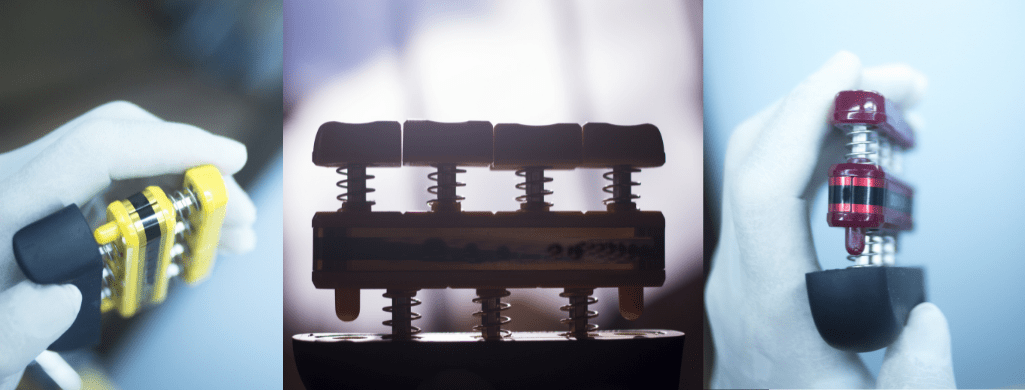
Hand exerciser, guitar finger strengthener, finger exercise tool. Different names, same application. If you are looking to build hand and/or finger strength, these tools can be extremely useful. However, we recommend building finger strength actually playing the guitar. There is no substitute for this, PLAY THE GUITAR!

In situations where playing your guitar is not possible, these become a great second option for finger strength. They are small, portable and packable. You can use them at work, on the road, at home, almost anywhere and anytime which makes them very practical.

After reviewing multiple guitar finger strengthener tools, we have chosen the D’Addario Varigrip as our pick. This is due to the adjustable resistance and the simulated strings for callus building. We find that geared towards guitarists, this is the best option.

If you are looking for a finger exercise tool for therapy/rehab, we found the PROHANDS product lineup to be the best as they cater specifically to this purpose.

Below you will find our reviews for the best guitar finger strengthener.

D’Addario Varigrip


The D’Addario Varigrip is the only guitar finger strengthener on our list that is produced from a guitar-related manufacturer. Although most finger/hand exercisers operate in similar a way by providing resistance to individual fingers.

We think that a company in the guitar-related industry creating this product really shows who they have geared the design and function towards.

What we like about this guitar finger strengthener

The variable tension that is adjustable for each individual finger is great. No need to have to set all tensions the same if you have one or two fingers lacking or if you have a predominately strong single finger.

The ergonomic design ensures you are getting the most benefits from your finger exercises without using a level of grip strength that is not required.

By removing the palm padding, you get access to the molded, simulated guitar strings to help build and maintain calluses. We like this very much as it adds another level of usage that was well thought out.

What we don’t like:

There is no mention of exactly what the range of variable resistance is. We’ve found a lot of info that states either: “2-4 lbs” or “2-5 lbs”. However, the manufacturer does not clarify.

Dynatomy VariGrip Sport


The Dynatomy Varigrip Sport is based off the same design as the D’Addario Varigrip. We like the D’Addario very much and we feel the same about the Dynatomy.

What we like about this guitar finger strengthener:

Again, the variable resistant adjustment is highly beneficial. The Dynatomy Varigrip Sport comes in two different resistance variations:

  • Medium – Extra-Heavy: 6-9 lbs variable, adjustable resistance
  • Extra-Heavy – Extra-Extra-Heavy: 9-12 lbs variable, adjustable resistance

The simulated molded guitar strings under the palm pad are highly beneficial and a great addition. You can build and/or maintain calluses with ease.

What we don’t like:

People seem to have an issue with pinching their fingers if not completely centering their fingertips on the plungers.

Digi-Flex Hand Exerciser


Although not dedicated towards guitar players, the Digi-Flex Hand Exerciser is an effective tool with multiple resistances available.

What we like about this guitar finger strengthener:

Solid build, no issues with stuck plungers or pinched fingers. This is important as this device is labeled as a therapy tool. Quality and ease of use were well though out here.

Available in six different resistance levels:

  • Yellow: 1.5 lbs
  • Red: 3 lbs
  • Green: 5 lbs
  • Blue: 7 lbs
  • Black: 9 lbs
  • Grey: 11 lbs

What we don’t like:

Take it with a grain of salt, but for monetary reasons, we prefer a variable finger exerciser as there is no need to buy all six to have a variable resistance range.

PROHANDS Gripmaster


Claiming to be “the original spring-loaded hand and finger exerciser”, PROHANDS Gripmaster is said to be used by professional athletes, musicians as well as a rehab tool. The design is similar to the Digi-Flex and has has different un-adjustable resistant levels depending on the device.

What we like about this guitar finger strengthener:

The PROHANDS hand exercisers are comfortable and well-built.

PROHANDS has four different product lines for their hand exercisers:

  • VIA: 1 lb – 6 lbs (Gray = 1 lbs, Green = 2 lbs, Yellow and Pink = 4 lbs, Blue, Purple and Black = 6 lbs)
  • Gripmaster: 1.5 lbs – 9 lbs (Green = 1.5 lbs, Yellow = 3 lbs, Blue = 5 lbs, Red = 7 lbs, Black = 9 lbs)
  • Gripmaster Rehab: 0.75 lbs – 9 lbs (Tan = 0.75 lbs, Yellow = 1.5 lbs, Red = 3 lbs, Green = 5, Blue = 7 lbs, Black = 9 lbs)
  • Pro: 5 lbs – 13 lbs (Blue = 5 lbs, Red = 7 lbs, Black = 9 lbs, Gray = 11 lbs, Orange = 13 lbs)

Important to note is that the VIA and Gripmaster product lines are smaller and may be better suited to small/average size hands. If you have large hands you’ll be better off with the Pro version.

What we don’t like:

Although they’ve created a wonderful lineup of different product lines and resistances. We believe this may be overwhelming for someone who just wants to increase basic finger strength.

Django Hand Exerciser


Available in a four or five finger configuration, the Django Hand Exerciser is a variable resistance plunger type finger strengthener.

What we like about this guitar finger strengthener:

Great build quality, doesn’t feel cheap. This is a nice benefit, especially in a variable resistance version. Everything seems tight and gives us the impression it will last.

The adjustable resistance gives you the ability to change the tension between 3-7 lbs.

What we don’t like:

If you have large hands or strong fingers the maximum tension of 7 lbs may not be enough.

Guitar Finger Strengthener FAQ


How often can I or should I use these?

A guitar finger strengthener can be used everyday, even multiple times a day as long as you feel no pain or discomfort.

For how long per session am I able to use these?

There is no set amount of time, whatever you feel comfortable with. We recommend starting out with a few minutes and see how it feels. Gradually increasing your time of use is the best course of action here,

Do I need to use a guitar finger strengthener?

The short answer is no. These hand and finger exercisers are not a requirement. They are a tool that helps increase your finger and hand strength more effectively than building that strength naturally through playing the guitar.

Conclusion


The benefits of portability, adjustable resistance and callus builder make our choice for the D’Addario Varigrip as the best guitar finger strengthener as easy one.

A final note, if you feel as though the resistance from any hand/finger exercise tool is too low, simply add repetitions. No need to purchase multiple different units for a variety of resistance levels unless that is your preference or recommended by your physician for rehab.

Do you use a hand or finger exerciser? Let us know! Thanks for reading.

If you enjoyed this article, please check out our most recent posts:

Blues Driver vs Tube Screamer – Comparison Review

blues driver vs tube screamer

The BOSS BD-2 Blues Driver and the Ibanez TS9 Tube Screamer are two of the most iconic overdrive pedals ever made. Between them they’ve appeared on thousands of records, powered countless live rigs, and started more arguments on guitar forums than just about anything else.

They’re both overdrive pedals. They’re both affordable. They’ve both stood the test of time. But they do not sound the same, they don’t behave the same way in a signal chain, and the one that’s right for you depends entirely on what you’re trying to do.

We’ve used both — the Tube Screamer extensively, both hardware and as a plugin, the Blues Driver as a plugin across multiple amp sims. Here’s an honest breakdown with no fluff.


BOSS BD-2 Blues Driver

Check price on Amazon

The Blues Driver has been in production since 1995 and it’s not hard to see why BOSS has kept it in the lineup. It delivers a warm, thick overdrive that sits somewhere between a pushed clean tone and full distortion — closer to what you’d get from a cranked vintage amp than a modern high-gain pedal.

What it actually sounds like

The BD-2 has warmth. Real warmth, not the marketing department kind. The low-mids are full and present, the attack is soft enough that it doesn’t feel harsh, and there’s a natural sag to the response that makes single notes feel alive rather than clinical.

The flip side of that warmth is that the Blues Driver can get muddy — particularly if you’re running it into an already warm amp, using humbuckers, or pushing the gain past the halfway point. The low-end build-up is the BD-2’s most common complaint and it’s a legitimate one. Players who use it successfully tend to keep the gain conservative and use the tone knob to tighten things up.

Controls

Three knobs: Level, Tone, Gain. Simple.

A common approach among experienced BD-2 users is to set both the Level and Gain high — almost maxed — and then back off just enough to find the sweet spot for their specific guitar and pickup combination. This approach works better with single coils than humbuckers, which tend to push the low-end into muddy territory more quickly.

Who it suits

The BD-2 is best suited to players who want a natural, amp-like overdrive with some character. It rewards playing dynamics well — dig in and it breaks up, back off and it cleans up. Blues, classic rock, country and indie players tend to get the most out of it. Heavy rock and metal players generally find it too loose in the low end.

Best for: Blues, classic rock, country, indie
Less suited for: High-gain rock, metal, players who need tight low-end
Gain range: Low to medium — this is not a high-gain pedal

Check current price – BOSS BD-2 Blues Driver


Ibanez TS9 Tube Screamer

Check price on Amazon

The Tube Screamer is one of the most copied circuits in pedal history. The original TS808 came out in the late 1970s, the TS9 followed in 1982, and the basic circuit has been cloned, modified and referenced by hundreds of builders since. The reason it keeps getting copied is simple — it works.

What it actually sounds like

The defining characteristic of the Tube Screamer is its mid-range hump. It cuts low-end and boosts mids, which is the opposite of what many overdrive pedals do. This makes it sound thinner in isolation but cuts through a band mix like almost nothing else.

The overdrive on the TS9 is smooth rather than gritty. It’s a compressed, harmonically rich drive that’s instantly recognisable once you know what you’re listening for. Stevie Ray Vaughan used it into cranked Fender amps to get that singing, sustained blues-rock tone. The pushed, slightly compressed feel with sustain that blooms on lead lines — that’s the Tube Screamer.

One of the most effective ways to use the Tube Screamer is with the drive turned low — sometimes almost off — and the level cranked. Used this way it acts as a clean boost with a mid-range push that drives your amp into natural breakup rather than adding its own clipping. This is arguably its most powerful application and it’s how many professionals actually use it live.

Controls

Three knobs: Overdrive, Tone, Level.

The Overdrive knob is more useful at lower settings than many players expect. Don’t dismiss it because it sounds thin at high gain settings — that’s not what it’s designed for. Back the drive off, push the level, and let your amp do the work.

Who it suits

The TS9 is more versatile than it gets credit for. It suits blues and rock players as a standalone overdrive, but it also works exceptionally well as a boost in front of an already driven amp — tightening the response and pushing the mids into the mix. If you’re playing rock with a tube amp running at moderate gain, the Tube Screamer as a boost is one of the most effective sounds in guitar.

Best for: Blues, rock, pushing a tube amp into overdrive
Less suited for: Players who want a flat EQ response, metal with tight low-end
Gain range: Low to medium — excels as a boost

Check current price – Ibanez TS9 Tube Screamer


Blues Driver vs Tube Screamer – Direct Comparison

BD-2 Blues DriverTS9 Tube Screamer
Overdrive characterWarm, loose, amp-likeSmooth, compressed, mid-focused
Low-endFull — can get muddyScooped — tight and controlled
Mid-rangeRelatively flatProminent mid-range boost
Best gain settingLow to mediumLow (as boost) to medium
Works best withSingle coils, clean ampsAny guitar, tube amps
As a boostDecentExcellent
Responds to dynamicsYesYes
Price~$100~$100

The Real Difference — EQ Character

The most useful way to understand the difference between these two pedals is through their EQ character rather than their gain structure.

The Blues Driver is relatively flat in frequency response — what you put in is roughly what comes out, just with more grit and warmth. If your guitar sounds dark, the BD-2 will sound dark. If it sounds bright, the BD-2 will be bright. This makes it transparent and natural, but it also means any problem frequencies in your signal get amplified along with everything else.

The Tube Screamer actively shapes the frequency response. It cuts low-end (reducing mud), boosts mids (adding presence and cut), and rolls off harsh high treble. This is why it sounds so good in a band mix — it carves out exactly the frequency range where a guitar needs to sit.

For players who want a pedal that makes their tone sound more like itself, the Blues Driver is the right choice. For players who want a pedal that makes their tone cut through a mix, the Tube Screamer is harder to beat.


Can You Use Both?

Yes — and many players do. A common and effective combination is the Tube Screamer first in the chain as a clean boost (low drive, high level), followed by the Blues Driver for actual overdrive tones. The TS9 tightens the low-end going into the BD-2 and reduces the mud problem significantly.

That said, if you’re only buying one — read below.


Which Should You Buy?

Buy the Blues Driver if:

  • You want a natural, amp-like overdrive with warmth and character
  • You play blues, classic rock or country
  • You use single-coil pickups
  • You want a pedal that responds well to your picking dynamics
  • You’re running into a clean or slightly dirty amp

Buy the Tube Screamer if:

  • You want a pedal that cuts through a band mix
  • You want to boost a tube amp into natural breakup
  • You play rock and want smooth, compressed overdrive
  • You record and want a pedal that sits in a mix without EQ surgery
  • You want the more versatile of the two

Our preference: The Tube Screamer. The mid-range character and the ability to use it as a transparent boost make it the more flexible tool for rock playing. The Blues Driver is a great pedal but it requires more care with gain staging and amp matching to avoid the mud problem. The Tube Screamer is more forgiving and more consistently useful across different rigs.

Ibanez TS9 Tube Screamer on Amazon
BOSS BD-2 Blues Driver on Amazon


Frequently Asked Questions

Is the Blues Driver better than the Tube Screamer?

Neither is objectively better — they do different things. The Blues Driver is warmer and more amp-like. The Tube Screamer is tighter and cuts better in a mix. For rock playing, most guitarists find the Tube Screamer more useful. For blues and classic rock with a clean amp, the Blues Driver is hard to beat.

Can the Tube Screamer do high gain?

Not really. The TS9 is a low-to-medium gain overdrive. At high gain settings it can sound compressed and thin. It excels at low drive settings, particularly as a boost in front of an already driven amp.

Can the Blues Driver do metal?

Not well. The loose low-end and warm character of the BD-2 doesn’t suit tight, high-gain metal tones. For metal you’d be better served by a dedicated distortion pedal with tighter low-end response.

Are there better alternatives to both?

Yes, depending on your budget. The Ibanez TS808 is the original Tube Screamer circuit and many players prefer it to the TS9. The Fulltone OCD is a popular alternative to the Blues Driver for players who want a more versatile overdrive. Both the TS9 and BD-2 remain excellent choices at their price point — they’ve survived decades for good reason.

Do these pedals work with amp simulators?

Yes — both work well with amp sims and are widely used in DAW-based rigs. The Tube Screamer in particular is extremely popular for recording, either as a hardware pedal going into an interface or as a plugin. The mid-range character that helps it cut in a live mix is equally useful when recording.

If you’ve enjoyed this article, please check out our latest posts:

Hanging A Guitar? Best Guitar Wall Hangers, Mounts and Racks

best guitar wall hanger

This is our review for the best guitar wall hangers in 2021.

So you’re thinking about hanging your guitars? There are many reasons we choose to use guitar wall hangers, guitar wall mounts or guitar wall racks over conventional guitar stands. Including but not limited to:

  • Worried that children or pets may damage your guitars and you want to get them off the floor
  • Showcasing your fine musical instruments
  • Maybe you’re bored and it’s music room project day?

Whichever the reason, there are many different choices for wall mounted hangers. As you will see below, every one of these options is a proven, top-seller and well received by buyers. That being said, each item has it’s pros and cons. We’ve done our best to provide a helpful overview.

What we’ve concluded:

We’ve reviewed the best guitar wall hangers and guitar mounts available and found the Hercules GSP38WB PLUS Guitar Hanger to be the overall best choice. Our conclusion is based on styling, construction and guitar protection from scratches and falling.

We have named the Hercules the best guitar wall hanger due to the attractive styling and the auto locking system that uses your guitars own weight to engage the locking arms. This system proves effective at gently but securely holding your guitar in the wall mount.

Our runner-up choice for best guitar wall hanger is the Snigjat Guitar Wall Mount. It has a base that is made out of North American Black Walnut and is cut to look like a guitar headstock. The deep v-shaped hanger cradle design will make sure your guitar cannot slip off. We love the look of this, but believe the Hercules wall mount to be a more secure option.

What we like about our unique pick is the completely different design. These hangers look good and also function as a skateboard hanger.

We realize that everyone’s preference and needs differ, for a wide variety of reasons. That is why we’ve included reviews for all of the best guitar wall hangers, mount and racks.

Best Guitar Wall Hangers


String Swing Guitar Hanger

Finish/Color: Black Walnut or Oak
Protective Hanger Coating: High Density Rubber
Yoke Pivots/Swivels: Yes
Adjustable Width: No
Includes Mounting Hardware: Yes
Weight: 5.7 ounces
Dimensions: 5 x 3 x 5 inches
  • 100% wood base wall mount, finished in either black walnut or oak
  • The protective rubber coating is guaranteed not to mark your guitars finish
  • The yoke pivots to hold any type of headstock
  • Incorporates a cradle design to prevent guitar from slipping off the wall hanger
  • Includes block, yoke, 2 screws, 2 drywall anchors

What We Like:

The solid wood base with two different finish options is a nice look. We also like the cradle style padded hanger. This makes hanging your guitar nearly worry free as it cannot slide off and protects your neck and headstock from scratches.

What We Don’t: 

Due to the deep cradle (which we like!), some thicker locking tuners may get caught on the yoke when placing, removing guitar from hanger. Also, the width of the forks may not be wide enough for some classical, or wider neck guitars.


Gator Frameworks Guitar Wall Hanger

Finish/Color: Black, Satin Chrome, Cherry Mahogany, Maple
Protective Hanger Coating: Rubberized
Yoke Pivots/Swivels: Yes
Adjustable Width: No
Includes Mounting Hardware: Yes
Weight: 6.4 ounces
Dimensions: 9.3 x 5.9 x 5.9 inches
  • Wall mount plate hides mounting hardware
  • Includes foam wall mounting pad to protect wall from abrasions
  • Rubberized swivel yoke
  • Safe for standard polyurethane finishes
  • Not recommended for vintage/lacquer finishes

What We Like:

The decorative base cover hides the mounting plate and screws for a clean look. We also like the cradle style hanger to better protect from the guitar possibly falling.

What We Don’t:

The install kit is not adequate for the majority of situations. Customer seem to have issues with the screws and drywall anchors. Most recommend to use your own hardware.

Also, the manufacturer mentions that it is NOT recommended for guitars with vintage/lacquer finishes. We applaud them for letting the buyer know ahead of time, but still view it as a negative in our books.


WOGOD Guitar Wall Mount

Finish/Color: Black
Protective Hanger Coating: Soft Sponge Padding
Yoke Pivots/Swivels: Yes
Adjustable Width: No
Includes Mounting Hardware: Yes
Weight: 5.9 ounces
Dimensions: 5.2 x 4.17 x 2.32 inches
  • Black steel base
  • Four point mounting plate for secure fastening
  • Yoke cradle pivots to fit varying headstock shapes
  • Soft foam padding ensures your guitars finish will not scratch
  • 1 year quality guarantee
  • Includes pick holder and four picks

What We Like:

The four point wall mounting plate makes sure the wall hanger will be securely attached to drywall if used with anchors. The 1 year quality guarantee and pick holder with picks are also nice additions.

What We Don’t:

Although the four point mounting can be a benefit in drywall. If you were to try to mount this wall hanger to a wall stud you would face issues are these holes are 1-1/4″ apart. It would be best to mount to drywall or to a board and mount the board to the studs.


Ohuhu Guitar Wall Mount Hanger – 2 Pack

Finish/Color: Wood, Walnut
Protective Hanger Coating: Soft Padding Sleeve
Yoke Pivots/Swivels: Yes
Adjustable Width: No
Includes Mounting Hardware: Yes
Weight: 12 ounces
Dimensions: 4.33 x 6.3 x 3.35 inches
  • Solid wood base available in wood or walnut finish
  • Padding sleeve to protect guitar finish
  • Yoke pivots for different headstock fitment
  • Adjustable stoppers for added protection against guitar falling

What We Like:

Nice looking design and finish. The adjustable stoppers are a nice addition as the cradle isn’t nearly as deep as other options.

What We Don’t:

The mounting includes sub-par anchors and screws. Customers have found the screws too short and question the quality of the screws and anchors. Do yourself a favor and make sure to use better hardware.


Hercules GSP38WB PLUS Guitar Hanger

Finish/Color: Wood, Black
Protective Hanger Coating: Specially Formulated Foam Rubber
Yoke Pivots/Swivels: Yes
Adjustable Width: No
Includes Mounting Hardware: Yes
Weight: 8.8 ounces
Dimensions: 7 x 4 x 2.5 inches
  • Wood base
  • Auto-Swivel Yoke hanger for multi-angle adjustments
  • Auto Grip System can lock guitar in place.  Uses the weight of the instrument to engage and close the two arms.
  • Accommodates ukuleles, banjos and mandolins as well.

What We Like:

The Auto Grip System used to lock the guitar in place using it’s own weight is fantastic.

What We Don’t:

Supplied hardware. Customers again mention poor anchor quality and short screws.


Snigjat Guitar Wall Mount – 2 Pack

Finish/Color: Black Walnut
Protective Hanger Coating: Silicon Tubing
Yoke Pivots/Swivels: Yes
Adjustable Width: No
Includes Mounting Hardware: Yes
Weight: 10.5 ounces
Dimensions: 5.2 x 4.17 x 2.32 inches
  • Handmade and hand polished using North American black walnut hardwoods
  • Mounting plate is made to look like a guitar headstock
  • V-Shape hanger design for better anti-slip compared to flat hangers.
  • Hangers are covered with silicon tubing to protect the guitars finish
  • Pivoting yoke to accommodate various string instruments

What We Like:

The styling that resembles a guitar headstock is great. The care put in to hand polish the black walnut is appreciated.

What We Don’t:

Would prefer a foam padding instead of the silicone tubing around the hangers. If your guitar has a nitrocellulose finish you may want to wrap the silicon tubing to prevent a possible adverse reaction with your guitars finish.


Belfi Design Plywood Guitar Wall Mount

Finish/Color: Light Walnut, Oak
Protective Hanger Coating: Bonded Leather
Yoke Pivots/Swivels: No
Adjustable Width: No
Includes Mounting Hardware: Yes
Weight: 6.4 ounces
Dimensions: 4.92 x 3.54 x 5.67 inches
  • Natural molded plywood with bonded leather soft grip
  • Opening is 2.2” wide and will hold most acoustic and electric guitars
  • Different design than other guitar wall hangers
  • Also suitable for bass, violins, mandolins, ukuleles. 
  • Has pick slot on top of hanger
  • Can also hold skateboards

What We Like:

We like that the styling is different from most other guitar hangers. The use of leather to protect your guitars finish is another nice addition.

What We Don’t:

Not compatible with certain guitar headstocks due to the non-rotating hanger. Customers mention the installation hardware is not adequate.


Keebofly Guitar Wall Hanger – 2 Pack

Finish/Color: Brown, Black, Brown Pine
Protective Hanger Coating: Linen Wrapped
Yoke Pivots/Swivels: No
Adjustable Width: No
Includes Mounting Hardware: Yes
Weight: 1.86 pounds
Dimensions: 11.97 x 6.38 x 2.91 inches
  • 100% solid wood
  • Linen wrapped hooks to protect from scratches
  • Hook ends have larger wood cap to prevent guitar from falling/slipping off
  • Display shelf to hold capo, straps, tuner, extra strings and also has a notch for picks

What We Like:

Stylish and the shelf is a nice addition to be able to hold different items. The pick notch is a great idea.

What We Don’t:

Even though the hook ends have a cap to help prevent the guitar from sliding off, we are always worried about straight hangers.


Bikoney Guitar Wall Hanger

Finish/Color: Carbonized Black, Cement Grey, Vintage Black, Weathered Grey, Weathered Walnut
Protective Hanger Coating: Lint Covered
Yoke Pivots/Swivels: No
Adjustable Width: No
Includes Mounting Hardware: Yes
Weight: 1.26 pounds
Dimensions: 15 x 4.5 x 5.5 inches
  • 100% solid wood
  • Available in vintage white, carbonized black, cement grey, vintage black, weathered grey and weathered walnut finishes.
  • Shelf and hooks for your other guitar accessories.
  • 3mm deep notch to hold guitar picks
  • Lint covered hanger arms to protect the guitars finish
  • Hangers are bronze metal

What We Like:

Handy shelf and hooks to hold guitar accessories or other gadgets. We also appreciate the wood styling. The notch made for picks is a plus.

What We Don’t:

We’d prefer better protection on the hooks where the headstock will rest. The attached lint is lacking in our minds. We would recommend you add protection in the form of other padding.


Snigjat Guitar Wall Mount – 2 Guitars

Finish/Color: Acacia, Walnut, Zebra
Protective Hanger Coating: Soft Rubber
Yoke Pivots/Swivels: Yes
Adjustable Width: No
Includes Mounting Hardware: Yes
Weight: 1.65 pounds
Dimensions: 17.4 x 5.75 x 2.24 inches
  • Available in acacia, walnut or zebra wood
  • Rotable yoke for various headstock design fitment
  • Height offset of hangers to prevent guitars from colliding
  • Soft rubber coating on hangers to protect guitar finish
  • Positioning card included for easy hole marking and installation

What We Like:

The ability to hold two guitars, plus have the shelf, hangers and pick notch is all around great. The height offset is also a big bonus as the guitars may have been touching otherwise (two acoustics or large bodied guitars may still touch).

What We Don’t:

As mentioned above, two full-bodied acoustic guitars will still most likely touch. Unfortunate as you’ll have to be extra careful when placing or remove one of the guitars.

Buying Guide For Guitar Wall Hangers


When choosing a guitar wall hanger, there are a few different factors to consider.

Does the yoke pivot, does it need to?

Depending on the type of guitar you have, you may need to make sure that the hanger, mount or rack you choose has a pivoting yoke. If not, you may not be able to mount your guitar safely, or at all.

Is the hardware included sufficient?

If you are mounting to concrete or brick and the included hardware only contains wood screws and/or drywall screw and anchors, this will obviously not be sufficient.

A common theme we noticed when reviewing these hangers is people were not happy with the included hardware. If it looks cheap or doesn’t fit the application, make sure to obtain the necessary hardware to make sure you are mounting these hangers securely.

What protective coating is on the hanger? Why does this matter?

Whatever guitar hanger, mount or rack you end up choosing needs to have adequate padding to prevent any scratches on your guitars finish.

You also need to be aware of any hangers using silicone. Silicone can have a negative effect on certain guitar finishes, like nitrocellulose (also known as a nitro finish).

Guitar wall hanger vs guitar stand

They both have their place and uses. If you prefer a solution to get your guitars away from possible dangers (pets, kids, unruly adults, etc…) then wall hangers and wall mounts will be your best option. In addition to protecting your guitars, hanging is also a nice showcase for your instruments.

If you prefer not to drill holes in your wall or worry about installing hangers. And, if you are not worried about possible dangers at ground level. Guitar stands work perfectly fine, are portable and most do not easily tip over.

Installation Of Guitar Wall Hangers


We HIGHLY recommend you seek help if you are unsure the best way to mount your guitar wall hangers. The very last thing you want is your guitar falling off the wall due to improper installation.

Wherever possible, we recommended only installing your hangers into solid wood or concrete/masonry. Solid wood could be your wall studs, but could also be a board you affix to your wall studs and mount your hangers to.

If your walls are concrete/masonry make sure to purchase the correct anchors, drill the pilot hole the correct size and do not over-tighten your anchor screws.

If you must install directly in to drywall, take your time, make sure the pilot holes of the drywall anchor are not too big and just as with the masonry anchors, do not over-tighten the screws.

Here is a helpful video from String Swing showing how to attach their guitar wall mount to drywall:

FAQ


Are guitar wall hangers bad for the guitar?

No, for 99% of guitars, using a guitar wall hanger or mount is perfectly acceptable. The only guitar we wouldn’t recommend this for is the solid brass 1979 Ibanez 2622 weighing in at 76 lbs. Not a typo, solid brass and 76 lbs.

What is the proper height to hang a guitar?

The proper height is whichever height you choose! There is no height that offers any benefit unless you have an obstacle.

What is the best way to hang a guitar on the wall?

The best way is whichever way ensures your guitar wall hanger stays mounted. Depending on the makeup of the wall, your install method will differ.. Drywall and concrete/masonry require anchors. You can also mount to a stud or header board with wood screws.

Do guitar wall hangers need studs?

Short answer, no.  However, it is extremely recommended that you do not just rely on drywall anchors. You can and these do work but know that the possibility of the hanger coming off the wall is greater with anchoring to just drywall. 

Can you hang a guitar on plasterboard?

Yes, you can mount a guitar hanger to plaster walls using masonry anchors (normally blue in color) as well as specialized anchors designed for plaster. Be sure NOT to use drywall anchors.

Our Verdict


There are plenty of guitar wall hanger options to choose from. Most are well-made and suited for the purpose of hanging expensive guitars.

That being said, we recommend the Hercules GSP38WB PLUS as the best guitar wall hanger. We really like the auto locking feature that will prevent the guitar from ending up on the floor, dented or possibly broken.

Just make sure that whichever guitar hanger, mount or rack you choose, you install it securely.

If you enjoyed this article, please check out our most recent posts: